Chuck Williams
Daisy Jones & the SixChuck Williams was the older rhythm guitarist whose brief place in the band that became The Six ended with his death in Cambodia. Recruited for his playing and remembered for surprising people who judged him by his clean-cut appearance, he left behind more than a vacant position: his loss sharpened Billy Dunne’s unease about surviving and succeeding while friends were sent overseas.
Joining the Band
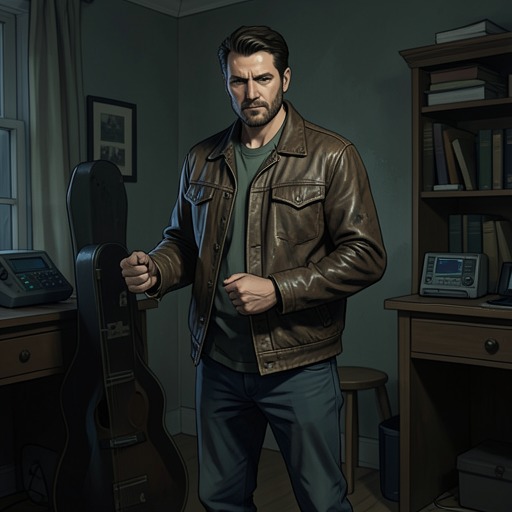
In 1967, when the brothers were still teenagers, Chuck joined Billy Dunne and Graham Dunne, drummer Warren Rhodes, and bassist Pete Loving. Pete knew Chuck and vouched for him; Chuck was a few years older than the others and came from a few towns over. His appearance made a strong first impression: Billy recalled blond hair, a square jaw, and a clean-cut look.
The audition overturned any easy assumptions. Chuck proved better than Billy at rhythm guitar. Billy wanted to become the front man, and with a full five-man band he could leave the rhythm-guitar part behind onstage. Chuck’s musicianship thus helped make possible a change in Billy’s role, even as Chuck himself became part of the group’s developing sound.
Warren remembered a different kind of surprise in Chuck. Though he looked as if he might never have had an interesting thought, Warren said, Chuck could cut to the heart of something. He introduced Warren to Status Quo, which Warren continued to listen to years later. This recollection gives Chuck a presence beyond his place in the lineup: he could make an impression through a perceptiveness that his appearance seemed to conceal.
The Draft and His Death
On December 1, 1969, the U.S. Selective Service System held the lottery that determined the order for the 1970 draft. Chuck, born on April 24, 1949, drew number 2. The number made his fate sharply different from that of the bandmates whose numbers offered greater protection: Billy and Graham, both born in December, had unusually high numbers; Warren narrowly missed the cutoff, and Pete’s number fell in the middle.
Graham recalled sitting at Chuck’s kitchen table as Chuck said he was going to Vietnam. Billy and Graham kept looking for ways he might avoid the draft, but Chuck said he was not a coward. Graham last saw him when the band played a bar by Duquesne. He told Chuck that he would come back to the band when he was done, treating the separation as temporary even as the draft made its danger clear.
The band initially carried on without him. Warren said Billy played Chuck’s parts for a while, but, as the group began getting more shows, the others invited Pete’s younger brother, Eddie Loving, to audition because he had become a capable guitarist. Billy likewise recalled not wanting to keep playing rhythm guitar onstage and thought Eddie could fill in for a little while. The arrangement was understood as provisional; the news that followed made Chuck’s absence permanent.
A few months later, the band heard from one of Chuck’s former neighbors. Billy said Chuck had died in Cambodia and thought he had been there for less than six months. The abrupt distance between Graham’s promise of a return and Billy’s account of his death turns an ordinary band substitution into a loss that the band could not repair by finding another guitarist.
Absence, Guilt, and Success
Billy described wondering why it had not been him, and what made him special enough to remain safe. Chuck’s death left survival feeling less like a deserved outcome than an inexplicable difference between friends. Billy’s conclusion was not that the world had offered a fair exchange, but that it made little sense.
That unease returned when The Six began to succeed. As a thirty-city tour was being planned after the album’s early buzz, Billy measured the band’s good fortune against the men they had grown up with: some were working three jobs, while others, like Chuck, were lost overseas. He said that a person might feel undeserving of success under those circumstances, then described refusing to think about the contradiction. The touring life offered a way to defer that reckoning: on the road, he said, it was almost like pressing pause on real life.
Chuck therefore remains a presence in the story even after the band brings in Eddie to play his parts. His death exposes the moral cost hidden beneath the band’s ascent, while Billy’s later response shows how success can intensify rather than settle survivor guilt. The band could replace a guitarist onstage; it could not make Chuck’s death fit into a reassuring account of who deserved to be safe.